


époque press
pronounced: /epƏk/
definition: /time/era/period

In the big top, banks of anoraks, wind-cheaters and chatter rebuff the chill. The ushers are having a hard time getting people seated. As if on cue, the rain tattoo subsides and a brisk fanfare claims the crowd. A hush falls. The space darkens.
At the centre of the ring – a clown in a cone of light. He’s white from pate to toe save for a bright red scarf and a bright red nose.
Goes by the name of Conc. What else, with a nose like that, a GO-red bulb plonk in the middle in his melancholy mug, a beach ball in an estate of trodden snow. Baggy jodhpurs. Half-metre feet. The knitted scarf is of epic length, fringes on the floor.
He shudders and shakes, jowls atremble, hands a-rubbin’, feet at work in a jig. We get the picture: it’s nippy. Suddenly distracted, he stops, puts on a clown-frown, strides to the edge of the ring, and peers into the audience. He’s spotting latecomers. He glares at them and jabs a finger at a pie-size wristwatch. Fists on hips, he taps a foot: thwack, thwack, thwack. It’s clear who’s in charge here.
His roving gaze freezes. Eyebrows go up. The scowl turns turtle. Ah, he’s chosen his charlie. A spotlight sweeps across a tier of faces and pounces on a clean-cut gent caught groping his way along a row of thin smiles. His startled eyes lock with Conc’s. And Conc is down the steps, flip-flop, flip-flop, and along the ringside seats, treading on the ends of the scarf, and up an aisle. He insists the gentleman joins him. The poor chap’s got no choice. He shuffles back along the row. Conc welcomes him with a bouncy hug. Aghast at what might be in store, he allows himself to be drawn all the way along the front, up the little steps and into the ring, where he’s set in its centre as prize patsy.
Conc fondles his overcoat. He strokes its classy charcoal nap. The fellow wants to be a good sport. He acts like he’s having a good time. He isn’t. No place to hide in a spotlight. Conc digs a pizza from a pocket and takes a whiff. Holding it at arms length and pinching his big red nose, he offers it to his pal. The audience is served a large-lidded wink. The chap’s stiff smile says: "Mercy, let this end." His playmate has other plans. There’s a no-holds-barred glint in his eye. The pizza’s just a taster.
To seal their bond, Conc proposes an exchange – a woolly scarf for a silk cravat. He winds the scarf round friend’s neck and then, with po-faced care, arranges the lengths.
This over, Conc focuses on the cravat: elegant, dove-grey. He closes his eyes and it whispers against his cheek. Light as air, it wafts from his fingertips. He blows it into a billow and it’s airborne, a fluttering bird. As he catches the creature, it vanishes. He draws silk through a gap near his thumb and – ta da! – it’s the cravat once more. He lets the magic linger, then abruptly blows his nose on it, honking like a horn. He shakes it out, tucks it into his collar, and takes a bite of pizza.
The battery of pats and back slaps have marked the coat with powder and greasepaint. There are smears, finger trails, entire handprints. Conc sets about the problem, but the more he swabs and dabs, the worse it gets. Old marks streak or get rubbed in deeper; new ones are applied. The well-groomed face sports smudges and daubs of its own. Conc spits on a corner of the cravat – ptui, ptui, pifth – and deals with them.
Conc ponders the problem, scratching his nose, boozy badge of mayhem that it is. He’s had a brainwave. He has a plan. He exits – and instantly returns wheeling an outsize washing machine. It has one great glass eye like a porthole, dials and switches and lights. A jumbo box of washing powder promises not to disappoint. Affecting the obsequious manners of a valet, Conc removes Sir’s coat. He presents the ruined garment to us with the panache of a matador. This is the Before part of his Before / After demo.
The machine’s eye is flapped open and the coat stuffed in. There follows a snowstorm as soap powder is shaken into the machine and well beyond. The hatch is shut, dials are dialled, a coin – supplied by Mr Obliging – is dropped in the slot, and a lever plunged. The contraption shudders, the eye whirls, foam froths out, and what one hears is Niagara in full spate. It clunks to a halt, then enters its cyclonic spin-dry phase. This wheezes to an end, and the machine gives out an amplified ping!
The showman snaps open the hatch. He pulls out the coat. Oh dear, it has not been restored to respectability: it’s a thing of shreds and gashes. The hem hangs, pockets peel, buttons dangle. Disaster! Conc gives a quick rendition of an Edvard Munch scream. He helps put the coat back on, ripping away a strip or two as he smooths it down. The guy is doing his best to play along but he’s squirming. The audience squirm – and grin, guffaw, and chuckle, tickled pink by his predicament.
Conc, a dab hand at mugging with a block of wood, does neat work on the dull gent. He treats the fellow like a prop, improvising on him as he would with a rubber saw, a collapsing table, or a fried egg gummed to a pan.
Anarchy and inversion – we lap it up, thankful one and all for the shadowy safety of our seat, glad it’s not us in the spotlight. For it’s always ourselves capering there. Deep down we know this. We scamper and dash, pretending time matters, but in no time the clock face will be blank – no hands, no numbers – as indifferent to us as a nun-white moon. After entrances and exits, what’s left? – an empty ring, a naught, an iris without a pupil. Knockabouts and spectators, players and patrons, buffoons and bystanders – no difference – we gambol, then are gone. All the unhinged bounce and whimsy, jollity, hubbub, striving – all dissolve into a night that never ends.
Conc takes a second to wind his watch – creak, creak, creak.
And now the two of them sit shoulder to shoulder atop the washer. Backs to the audience, they gaze across an expanse at a prospect of unending darkness.
*
Unending darkness … yes, but it’s on Pause for the moment. First comes a sound – barely there – like a low moan from a far room, or a mesh of slow howls. It is a wash of pains, this cold wind. Beyond the dim arc of the arena, something is forming: an island of white in a sea of darkness. It’s a small wood, a grove – bare branches bend in the wind – and, coming into view, huddled bodies, clumped like trunks, branching arms and holding branches.
The impression is one of whiteness – a whiteness of many whites, putty, paper, hoarfrost, potash, bonemeal. Here a pale wafer, its petal-yellow lost to time; there, a snatch of lichen that once was emerald. The faded flakes aspire to a state of colourlessness. All is white upon white, save for one keen note of red here and there, brave as a poppy, refuting pallor.
And the wind does its work, sighing and calling and bending the boughs, but all getting a bit overdone now. And look: the grove shuffles into the ring – the mood changes gear with a jolt – and we see it’s a sort of Birnam Wood come to Dunsinane, as presented by the Midsummer Night Rustics, out of season and still in rehearsal. A clan of clowns here, worn and weathered, having in common the cold days and grey hours. Before us they stand, beached on earth’s bald dome, bumpkins and farcicals, the clowns of winter.
The wind gives way to a wonky waltz, and the wood breaks into a party of seven.
They stack the branches for a bonfire. A match is brandished. Just as the box is about to be struck, the match is snatched, and it’s a small spat that flares over who gets to light the fire. This is followed by a bit of bargaining, a difference of opinion, a little tantrum and – in quick succession – a push, a shove, a pout, and stand-off. Sparks fly. Then it’s dirty tricks, tit for tat, snipe and broadside, and some tongue-pulling. The squabble is settled when the tallest character, using his height as unfair advantage, holds the match out of reach of the rabble, dousing the flames of anarchy. The plump one – he’s been dying to do it – bangs a little gong. All this in a neat sixty seconds.
Commonality rekindled, they circle the tepee of twigs, wide-eyed and expectant. The match is raised, descends, strikes … but does not ignite. Ah, bathos: life’s essence! Dismayed, they gape at each other, then shrug it off and settle into a show of shivering. Each happens to have handy a spare set of teeth, and these are used as chattering castanets. A bunch of noodles, loons, and layabouts. To keep warm, two bozos pair up and share a coat, each with an arm in a sleeve, then partner in a tango. The short one leads.
*
Here, gentle reader, a pause in the action – not an intermission; do not leave your seat – an entr’acte of sorts, in which the clowns are catalogued and their common predicament sketched. We take a closer look to see who’s who.
Conc and his nose, we’ve met.
Now, Palaeo. Palaeo is the tall one, the ancient of the tribe. Though colour has leached from his frame, a certain spry note persists. His tailcoat is a gaunt, hollow-cheeked garment with a skin condition, but its lapels still wink a few last sequins. At his neck, a white bow tie opens like a moth. The face is a quarry of clefts, a tissue of crepe over bone, eye sockets bruised by darkness. In good time: two culs-de-sac. But for now, he bends a spindly limb, brittle as a biscuit, and joins in the romp. There are twigs in his hair. Wisps stray. Threads trail fingerless gloves. This is a delicate decay, a shedding in increments, like leaves dropping one by one; a whispered dusting away of detail and unloosening of the spirit. Heigh-ho.
Next is Bigwig, the bossy buffoon. He’s quite another caste of clown – Bigwig and Palaeo are cheese and chalk. His one-piece romper is creased as the crust on camembert. His wig, a neon-red electrocution of frizz, is held down by a well-dented, once-white top hat. Bigwig has two modes: Up and Down. The bouncy mode has lots of whack, bonk, slap, twang, toot, and clang. It’s then that his blood-red, monster-size boxing gloves come in handy. But, in blear-eyed mode, he’ll sit slumped in lumpen gloom, scratching a flea bite or patting his hat.
Poles apart from Bigwig is the button mushroom with a fey air and a brass gong. His name is Ronald. Ronald, though pint-size, is bigged-up by a bouffant of cotton candy. Cochineal freckles speckle his face. Appended about the pumpkin of his person are a family of dimpled, swollen parcels. All sorts. Some bulge like bladders, some resemble ravioli. These dumplings are padding for buffets and bangs, ballast to steady the boat. From time to time a packet detaches and plops to the floor. He picks it up and hooks it back on as if latching a piglet to a teat. He rearranges, he stock-takes. All this dilly pother!
And here’s Ho Ho Lee. This funster specialises in vents. Ho Ho Lee’s garments are full of holes. There are holes the size of clown-yawns. You can see holes through holes. Elbows are gone. Zips gape. Soles flap. His long johns are threadbare – naked knees peep through jaggy slits like bloodshot eyes. Clown-o’-‘oles has built an identity around lacunae. Vacant spaces make him special.
Quirk’s the norm in Clownland. Hand-me-down pyjama pants, an edible hat, a twitching tie – it’s a matter of personal taste, a question of style, a triumph, in fact, of style over context.
Take, for instance, mould. Mould can be a point of pride. Nothing to be ashamed of in creeping damp or garments rich in blemish. Scale adds character; an object reduced to process has personality. Exemplifying this, we have the character listed in the program as Bog. Bog’s kit is a harmony of dubious whites – Roquefort, sago, and tripe. A large flap in the seat of his saggy trousers hangs open like a suitcase lid, offering a free view of tartan underpants. The clan pattern of red and grey is set off against flesh that brings to mind the filmy sac that sheaths a haggis. Bog’s hulk is the equivalent of a burp. His red-rimmed, rheumy eyes are forever lost in thought for he is the intellectual of the group.
This mishmash of oddballs is united in disruption, allied in absurdity. Card-carrying lifelong union members, every one.
Jesters: Solidarity! Long live our jamboree!
Moving down the list, we come to Hilton, the soft-hearted simpleton with cheeks of yoghurt and the look of a semi-colon. His mittens don’t match, his shoes aren’t a pair, the gawp is lopsided, the grin skew-whiff. This wistful twit’s a natural for playing the village nitwit. His ruff, once starched and pleated, now looks nonplussed, and no longer snowy, but potato-beige. His jacket has three goon-size, robin-red buttons. Rouged on the tip of his nose is a strawberry dot. It perches there like a sold sticker garnishing a plate of poached hake. The long, lank hair is winter-white. He is both young and old. Hilton, the simpleton.
Lastly: the dandy of the pack. He boasts an umbrella, a claw-like spiny thing with ribs awry, of no use in a drizzle. Snatches of cloth cling to it like the last leaves of autumn. He is fond of his brolly. He swings it and twirls it, man-about-town and just the thing. His natty vest is fashioned from newsprint, but it’s plush scarlet for his feet: a pair of papal slippers. A debonair quiff perfects the cut of his jib. Set solid, its wake of waves are frozen mid-swell. Dee’s the name, Dan Dee.
So:
Conc
Palaeo
Bigwig
Ronald
Ho Ho Lee
Bog
Hilton
Dan Dee
Here’s a face of soot and flour, and one like whey; there, a countenance of wax. Exiles all, out in the cold. Yet, on they go, stubborn as weeds, gaunt yet jaunty: Jam tomorrow! They’re the very picture of woe, but a picture animated by prank and antic; buoyed by an updraught of fun, a gust of mischief, a current of irony. It may all be futile but, now and again, a defiant note of red – brief and bright as a ladybird – claims its moment.
*
And now – yes, yes, at last – on with the show!
We’re back with Conc again. He’s standing on the washer, trying to get the attention of the team way over on the other side. He yodels. He halloos. He beckons. He waves the pizza.
The misfits migrate over, taking the long route round the ring, milking the laughs. It’s a procession of lopes, skips, and ambles, with Bigwig – in glum mode now – slouching at the head, and Bog’s cumbrous lumbering bringing up the rear. Somewhere in the middle, the stalky senior, Palaeo, is an articulation of oddities. His limbs have the fickle-hinged joints of a marionette. Without warning, knees and elbows kink and buckle like straws; an arm can bob for no reason. He walks as if treading on wet paint. Also aboard are Ronald and his parcels. The puffy chattels, fubsy pouches and corn-fed purses bounce about him as he goes. Ronald doesn’t travel light. Hilton and Bog – clot and clod – play leapfrog along the way.
In the fullness of time, the caravan reaches its destination. Conc and the chap stand waiting. Introductions are made, punctuated by curtsies, hand kissing, and farts.
The newcomers are taken by the tattered overcoat. They paw and poke, flap strips, flick buttons. The chap takes it off, assisted by many hands. Then it’s turned inside out, which thrills everyone even more. In the end he’s obliged to put the garment on again, raggy lining out.
A change of focus. Bigwig has a big idea. He insists – in mime – that the wigwam be demolished, its branches snapped into lengths, then fed into the washing machine, which can double, it seems, as a heater.
It’s an excuse for another parade – this time contrariwise, then back again. A tinny march strikes up, Ronald bangs his gong, the brigade struts its stuff, and the audience joins in, clapping on the beat. Sticks flip hats, trip pals, tickle ribs. They’re good for swordplay too: Palaeo parries phantoms. The gross oaf Bog clomps along with an armpit over a forked-stick crutch, while The Chief (you know who), pleased as Punch to have poached the biggest branch, wields it as a marching mace, leading the troupe with a swagger. His red gloves swing on their laces like bloodied trophy from the hunt.
Onward, bigfoot soldiers, guardians of drollery!
The simpleton is duped out of one of his red buttons. It’s dropped in the slot, and now it’s business as usual with the dials and lever and whatnot. Belching smoke, the porthole fires up and they warm noses, fingers, feet, and bums.
But everything passes: glow dims, fire dies down. They get irritable. There’s a petulant push from Ronald, a taunt from Dan Dee. Two scowlers stomp on each other’s toes. Slapstick gets reckless; squabbles break out; an edge of menace creeps in. Caught in the middle of it all, Chap’s a sitting duck. Manners won’t help a gent here. It’s jape after jape and no sign it will cease. He looks to Conc for a crumb of hope. Fat chance, not a sausage.
The gang ambush the chap’s attention while Bog, on tiptoe, sneaks behind him, picks a strand of the cherry scarf and gives it a little tug. And another. Stitches unravel. Unobserved, the boys take turns pulling the thread, yanking the yarn across the ring. It’s a circus! The chap cottons on just as the scarf crumbles away. Bamboozled! And his ordeal ain’t over. The posse grab his ankles and wrists, swing him – a shoe hurtles into the yonder – toss him high, and catch him in the nick of time. He stands off-kilter, mugged by fun, a clownish spectacle, with features defaced and hair a quarrel of spikes. Loops and tangles of red wool lie about like paint dribbled from a hole in a bucket.
A cacophony of clowns, champions of chaos, they’re intoxicated with pandemonium, in love with shambles. The crowd of blood-lusting Romans urge them on.
Hello, this is something new – the yapping of a high tenor. All heads turn to the washing machine. Circled in the washer window: a dog. The hatch is opened and out leaps a terrier – trim, tufty-white with one black spot, and frisky as a flea. He shakes the ruff that circles his mutt, woofs down the pizza, seizes the spotlight, and steals the show. Oh, they don’t like that at all. Dan Dee makes a grab at him but, way ahead of the game, Spot darts off in a merry dash round the ring twice, followed pell-mell by a hullabaloo of funnymen tripping over feet, treading on heels, and pulling the washing machine which snags the red twine, and quick-quick pooch and pursuers and all-purpose appliance are gone.
And suddenly the ring is empty. Chap is alone.
He waits. We wait. A snigger breaks the silence. Someone coughs. No one comes. Poor mutt. It’s all gone too far.
The ring is a disc of ash. Neither night nor day, it’s a world of grey dusk or grey dawn. We apprehend a place from which colour has drained, and where nothing remains of everything there was. There is only the winter wind – a sound that feels like silence.
He whistles a wisp of the droll waltz. It fades like breath on cold air. But out comes dog Spot, scampering up to lick his lonely hand. A woof for the crowd, and the little wag is off again and gone.
Again, aloneness.
We become aware of a red dot at the very centre of the grey ring. He walks over and picks it up. Yep, it’s a nose – round as a plum, red as a berry. It gets a blank stare. We wait for the penny to drop. It does: plink! With nothing left to lose, he puts on the nose – we are witness to a sacrament – and turns to face us: Chap, the clown.
The crowd roars its approval. He bows.
From out of nowhere: a hollow ohm-pa-pa and the sad, soulful, merry, weary wail of a trumpet. He reaches into the coat and brings out three balls – red, yellow, blue – and, before we know what’s happening, they’re in the air, leaping, falling, criss-crossing, weaving arcs. It’s pure moment – without past, without future. He catches all three in one hand, and in a trice conjures six more, multiplying the joy. The audience is aglow.
Initiation complete, he somersaults – pure present – off the edge of the ring.
He passes along the front rows and up the aisle, journeying back to his seat, his new nose bobbing like a ripe tomato. He finds his seat and waves to us all. Applause dies away, and we turn back to the ring – for the rite is not yet over. There remains a final tableau to celebrate our carnival.
The sacred circle is dark once more. Again, the winter wood, a tracery of twigs, the bleak wind . . . but listen . . . now its call comes from amongst us too, a whisper from a single seat – Chap’s perhaps? – and ripples outwards, growing till it seems the whole great tent is the sound, a shimmer of evanescence – hisses, soft, indefinite; and unending wordless breaths, whistlings of the subtlest assignment. Slow splashes swell in a thousand ways from a thousand places. And not one voice – not one – breaks the contract of delicacy, solemnity, and play. It is a wash of beauty, shared.
It passes like mist at dawn, this easing of an icy wind, this gentling.
Leaving stillness.
The ting of a triangle sets a rhythm; an accordion offers a tune. And we’re off again: enter the clowns. Enter the trees: they shuffle into dappled light. But now, in amongst bare branches: new leaves, leaves of every colour – a glint of blue, of yellow, and coral and emerald and purple, and a leaf of spring-green too. The clowns of winter lift their faces, faces full of hopeless hope.
Spot nips in, nicks a leaf, and does a dash.
Against a vacant sky a silk bird swoops – grey – silent – down and away.
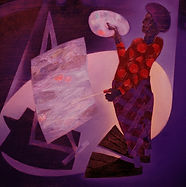
Michael Pettit is an artist from Cape Town – a painter – with works in the SA National Gallery and other major public collections. He also writes. A Pushcart Prize nominee, his stories and poems have been published in The Barcelona Review, Meniscus, Thin Skin, Frazzled, and other journals. They have been shortlisted, placed, or won competitions including those of Wells, Hastings, Parracombe, MTP, WestWord, Bournemouth, Hammond House (three anthologies and an Editor’s International Choice award), and the 2025 Plaza Short Story Prize judged by Booker Prize winner, Damon Galgut.
Of the story featured here, Michael says:
'As the story unfolds, the madcap clowning in the circus ring gives way to deeper, more poetic layers revealing an archetypal journey. We, members of the audience, watch Chap endure a rite of passage.'