


époque press
pronounced: /epƏk/
definition: /time/era/period

Timtriallach 1, 2, 3
(Medium: Wax Paintings)
Timtriallach, from the Gaelic for cyclical, embodies the deep rhythms that shape Deep into the Psyche of the Land-Mo Anam Cara. These three circular works, created on reclaimed wood, grow from my three‑year ritual cycle of making outdoor sculptures across the boglands. Each circle becomes a marker of time lived with the land, a return to the same places, gestures, and seasons.
I melt and layer beeswax from Richie Brennan’s hives on the Graine moor with seeds, plant remnants, bioplastic, and oil paint, building the surface like peat forming over years, trata of breath, pressure, and memory. The embedded seeds echo the cycles of growth, decay, and renewal that define bog ecologies, while the circular forms reinforce the sense of continual return: no beginning, no end, only movement through phases.
The works honour the Celtic understanding of time as spiral rather than linear. My three‑year sculptural cycle becomes a contemporary ritual, mirroring the triads found throughout Irish cosmology, land, sea, sky; past, present, future; body, spirit, earth. Each piece holds the imprint of walking, gathering, listening, and returning.
Timtriallach deepens the theme of ritual as something lived and layered. These three circles sit like small constellations of time, tender, grounded, quietly powerful, reminding us that to live with the land is to move in cycles of making, unmaking, and becoming again.


Súsán (Moss) – breath of the bog, builder of beauty
(Medium: beeswax from Richie Brennan’s hives at Graine moor, natural materials (bog seeds & moss), bioplastic, oil paints on board)
Súsán grows from my ritual practice of working slowly and attentively with the land. Using beeswax from Richie Brennan’s hives on the Graine moors, along with sphagnum moss and seeds gathered on the Inchirourke bog, I melt and layer these materials with bioplastic and oil paint onto board. The process mirrors the bog’s own formation, wax poured, cooled, returned to again, building strata like years of peat holding memory.
Sphagnum moss, the true builder of the bog, becomes both material and metaphor: soft, porous, life‑giving, the bog’s breath. Embedding it within beeswax is a small act of honouring, a gesture of reciprocity between artist and land.
The surface holds a quiet stillness, sensitive and skin‑like, inviting a slower kind of looking. It carries the same calm found on the bog at dusk, shaped by years of walking, gathering, listening, and returning. In the exhibition, Súsán becomes a site of reconnection, an intimate ritual made through layered time, a small ceremony of material, memory, and belonging.

Blue light on the bog – Tine Ghealáin-Oh last night, I spied will o’the wisp... flashing along the hinterlands, .. calling me over.
(Medium: beeswax from Richie Brennan’s hives (Graine Moor), bog lichen, bioplastic, oil on reclaimed board)
A blue flare on the bog is where this work began. One summer night, sitting out late along the Black River near the old railway line by Inchirourke Bog, researching, thinking, observing, I saw it myself: that will‑o’‑the‑wisp, the ghost‑light folklore says rises from moss and waterlogged earth. A misleader, a guide, a beckoning. It pulled me over, and the encounter became the seed of this piece.
I melt beeswax from Graine Moor and layer it onto reclaimed board with bog lichen, bioplastic, and oil paint, building the surface like peat forming over centuries, wax poured, cooled, scraped back, returned to again. This ritual of layering echoes the bog’s own slow alchemy of preservation and decay.
Inchirourke Bog was surveyed in 2006 as part of Bord na Móna’s Littleton group: “89 hectares bordered by Baunmore Bog to the north and Longford Pass to the south. The survey uncovered a 240‑metre plank trackway dated to around 1607 BC and archaeological wood...”
...fragments of human presence held in peat, like the layers I build in wax and paint.
A quiet invocation, a shimmer at the edge of the hinterlands, Tine Ghealáin holds that moment of being called over.

Where land and water meet
(Medium: mixed media on canvas)
This painting arises from that charged threshold where land softens into water, where boundaries blur and the world becomes briefly more ancient, more permeable. The Spa Hill rises in the distance, with The Lochans the “little pools”gathered in the foreground, a landscape long shaped by flooding, seepage, and the quiet labour of time. The place-name history of Balief, Baile Aoidh, and the ruined Shortal castle nearby root the scene in centuries of human presence, while the large rath on the upper ground speaks to an even older cosmology of settlement, protection, and ritual orientation, a place that is sacred to the artist who has wandered up to its pinnacle since she could first walk, alongside her father and siblings to gather hazelnut and all the wholesomeness held within.
The work draws from this layered heritage but focuses on the elemental meeting point itself: the shimmer where water gathers in hollows, the shifting edge where soil gives way to reflection, the moment when the land seems to breathe differently. Through mixed media, textured surfaces, and subtle transitions of colour, the painting holds the tension between solidity and fluidity, between what is grounded and what is always moving.
This is a landscape that remembers. The Lochans, liable to flooding, act as seasonal mirrors, returning sky to earth and dissolving the certainty of fixed form. In painting this place, I lean into that liminality, allowing the materials to echo the slow seep, the pooling, the quiet transformations that shape the land. The work becomes a meditation on thresholds: where histories meet, where elements meet, where we meet the land in its most honest state, unfixed, breathing, alive.

My Wildfire
(Medium: acrylic and organic bog‑plant pigments on canvas)
My Wildfire is shaped by the poem’s longing to be taken back into the raw, untamed heart of the bog, a place of immersion, surrender, and deep remembering. The work moves between the dark depths of the bog and the bright tenderness of heather‑filled meadows, holding both the fierce pull of wildness and the quiet ache of love. The opening lines“Bring me your wildness… Take me to the soul of the bog” speak not only to the land, but to the beloved: a desire to be met fully, to be transformed through closeness.
Using acrylics mixed with pigments made from bog plants, the painting carries the physical presence of the landscape. Grinding and blending these organic colours becomes a ritual of embodiment, echoing the poem’s movement from murky waters to the lightness of running through spring fields. The brushstrokes follow the body’s instinctive rhythm, yes closed, breath steady until painting becomes a form of devotion.
Heather threads through the work as a symbol of tenderness and longing. In the poem, it rests in the hair like a quiet vow, a reminder of the softness that survives even in wild terrain. The bog becomes both lover and landscape, absorbing, shaping, calling you back. The lines “You absorbed in me, with me, through me” hold the metaphor gently: love as something elemental, something that seeps in like water through peat.
My Wildfire becomes a rite of return to the land, to the beloved, also to the self that is born of earth and shaped by water.
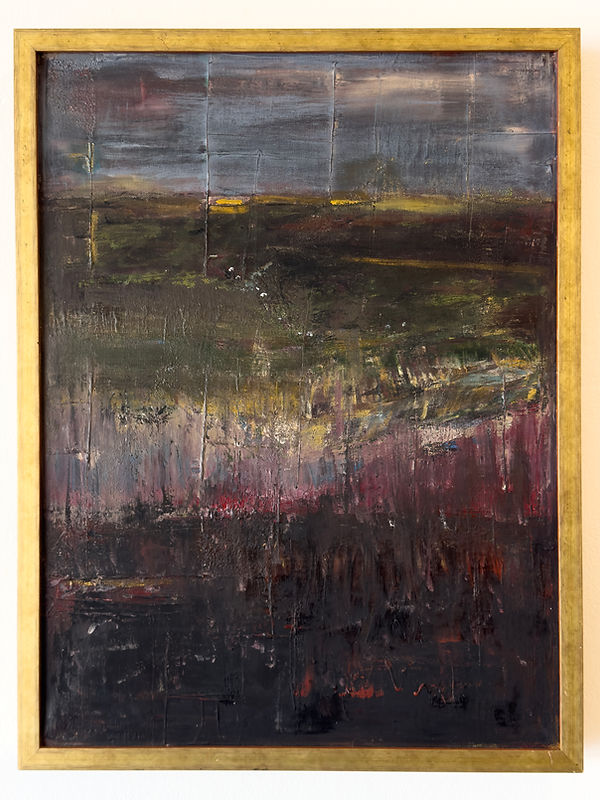
Shúigh sé isteach boladh an fhraoigh
(Medium: beeswax from Richie Brennan’s hives at Graine moor, natural materials (bog heather), scent from plants extracted, bioplastic, oil paints on reclaimed board)
This work emerges from the deep ecology of the wetlands, where heather, water, and peat shape a world that is both fragile and ancient. The title Shúigh sé isteach boladh an fhraoigh (“he breathed in the scent of the heather”) evokes a moment of surrender to place, a young man leaning into the land until its fragrance becomes part of him. The painting holds that threshold where human presence dissolves into the bog’s vast, breathing quiet.
Beeswax from the Graine moor is melted and layered onto reclaimed board, creating a surface that mirrors the slow accretion of peat. Bog heather, gathered and infused for its scent, becomes both material and memory—its presence a reminder of the plant communities that build and sustain wetland ecologies. The negative space in the composition echoes the open, absorbing stillness of the bog: a place where sound is swallowed, where orientation slips, where one can be lost and found in the same breath.
Wetlands are liminal by nature, neither land nor water, but something in between. This piece leans into that in‑between state, where the boundaries of the self soften. The young man in the title becomes a figure of ritual: stepping into the dark depths, inhaling the heather, allowing the land to enter him. It is an act of devotion, a quiet merging with a landscape that holds both danger and solace.
The work becomes a small rite of passage, an invitation to breathe with the bog, to honour its ecology, and to recognise the thin places where human and land briefly become one. The painting is to honour the artists’ two sons, and their deep understanding of the land around them.

Mary Doyle Burke is an Irish visual artist based in Kilkenny whose practice weaves ecology, ritual, and material memory. Working with beeswax, plant matter, handmade pigments, bioplastic, and reclaimed wood, she creates sculptural paintings and installations rooted in the wetlands, bogs, and moors she has walked for years. Her work explores ancestral lineage, land-based healing, and the deep psyche of place, often integrating poetry and sound. As founding director of An Chéad Tine Art Organisation & In House Curator, she also supports artists through studios, exhibitions, and public programming. Her practice embodies a contemporary ritual of return, honouring land, story, and the quiet ceremonies that shape belonging.
Of the art work featured here, Mary says:
‘Ritual in Deep into the Psyche of the Land , Mo Anam Cara unfolds as a continuum of land, memory, and lineage. It is not a single gesture but a sustained way of being with place. Across my current exhibition, ritual emerges through repeated acts: walking boglands, gathering moss and seeds, listening to wind and water, melting beeswax, layering pigments, and returning to the thresholds where land and water meet. These gestures form a contemporary ceremony rooted in ecological intimacy and ancestral presence.
My practice is shaped by years moving through wetlands and moors, liminal spaces that are always shifting. Her materials carry the imprint of these ecologies: beeswax from Richie Brennan’s hives on the Graine moor; bog heather, moss, lichen, and seeds gathered by hand; bioplastic that behaves like weather; pigments extracted from plants; reclaimed wood holding its own history. Each artwork becomes a vessel for these rituals of return.
Works such as Blue light on the bog -Tine Ghealáin, Súsán (Moss), Timtriallach 1, 2, 3, and Shúigh sé isteach boladh an fhraoigh embody cyclical time, folklore, and the dissolving boundary between human and landscape. Poems woven through the exhibition deepen this field of ritual, invoking ancestral presence, listening, immersion, and the body as an instrument of making. Ritual becomes intimate and communal, a way of chasing stories before they slip away, gathering remnants, and becoming, as one poem names it, “a visual storyteller… Land, Human, I am both, And one.”